13 April 2029: A 41-Million-Ton City-Killer Threading the Needle at 19,656 Miles (31,634 km)
Primary-source guide to the Friday, 13 April 2029 (21:46 UTC) perigee of asteroid 99942 Apophis—skimming just 19,656 miles (31,634 km) above the Atlantic Ocean (2,580 miles inside the geostationary satellite ring and under one-tenth the distance to the Moon), 750–1,200 megaton regional-devastation physics, 100-year hazardous/ELE close-pass comparison table, and unaided-eye viewing.
Key Orbital and Physical Parameters of the 13 April 2029 Perigee (21:46 UTC)
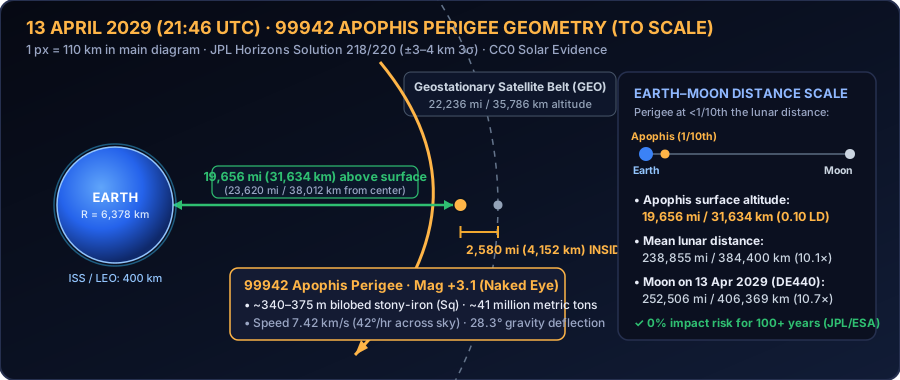
A 1,115-foot asteroid skimming underneath our TV satellites. At 5:46 p.m. EDT (21:46 UTC) on Friday, April 13, 2029, the 1,115-foot (340-meter) stony-iron asteroid (99942) Apophis will pass just 19,656 miles (31,634 km) above the Atlantic Ocean. That is less than one-tenth the distance to the Moon and 2,580 miles (4,152 km) closer to Earth than our ring of geostationary weather and TV satellites (22,236 miles up). Radar proves Apophis will miss us safely, but a 41-million-ton rock that size carries 750 to 1,200 megatons of energy, a reminder of why planetary defense matters. [1][2]
1. Distance above the ground (19,656 miles / 31,634 km). At closest approach, Apophis passes 23,620 miles (38,012 km) from Earth's center, which is 19,656 miles above the mid-Atlantic Ocean (29.4°N, 42.6°W). Because the Moon sits 252,506 miles away that night, Apophis comes more than 10 times closer than the Moon. [1][2][3]
2. Flying 2,580 miles inside the geostationary satellite belt. Our main weather and communications satellites (like NOAA's GOES-19) orbit 22,236 miles (35,786 km) above the equator. Apophis dips 2,580 miles inside that satellite ring, but because its path is tilted 40° to the equator, it passes well clear of active satellites. [1][2]
3. Weight (~41 million tons) & naked-eye visibility. Radar images from Goldstone and Arecibo show a peanut-shaped stony-iron rock about 1,115 to 1,230 feet (340–375 m) across, weighing roughly 41 million metric tons. On the night of April 13, 2029, under a dark New Moon (0.2% lit), Apophis will shine as brightly as the stars of the Little Dipper (magnitude +3.1), letting millions of people across Europe, Africa, and western Asia watch it glide across the sky with the naked eye. [3][4][5]
To-scale geometry of the Friday, 13 April 2029 (21:46 UTC) perigee of 99942 Apophis at 19,656 miles (31,634 km) above Earth's surface relative to the 22,236-mile (35,786 km) geostationary satellite belt and the Moon (252,506 miles / 406,369 km that night from JPL DE440). Original diagram, CC0.
How Close Is 19,656 Miles—and What Would Happen If It Hit?
How close is 19,656 miles? In space terms, 19,656 miles (31,634 km) is a hair's breadth—less than the distance around Earth's equator (24,901 miles), or about seven round-trip flights between New York and Los Angeles. At Apophis's approach speed, arriving at Earth's orbit just 50 minutes earlier would have turned a safe pass into a direct hit. [1][6]
What if a 1,115-foot asteroid actually hit Earth? While global dinosaur-ending asteroids are 1 to 6 miles wide, a 1,115-foot (340 m) rock is what planetary-defense agencies call a regional or state-killer:
• 750 to 1,200 megatons of impact energy. Hitting the atmosphere at 28,200 mph (12.6 km/s), an Apophis-sized rock releases 15 to 24 times the energy of the 50-megaton Tsar Bomba (the largest nuclear test in history) and 75 times the 1908 Tunguska airburst in Siberia. [4][14]
• A 3-mile crater and state-wide blast wave on land. Standard impact physics (Collins, Melosh & Marcus 2005) shows a land strike would blast a crater 3 miles (5 km) wide and 1,500 feet deep, trigger a magnitude 7.0 earthquake, and flatten buildings across a 60-to-90-mile radius, devastating an entire US state or European country. [14]
• Ocean impact tsunami. If a rock that size struck the mid-Atlantic Ocean, it would launch deep-water tsunami waves that would pile up into 30-to-100-foot (10-to-30-meter) waves along the US East Coast, the Caribbean, Europe, and West Africa within hours. [14]
Closest Large Hazardous & Regional/Global-Scale Asteroid Passes in the Last 100 Years (1926–2029)
The closest large asteroid pass in over 100 years. Checking NASA/JPL's database from 1926 through 2029 shows that Apophis's 2029 flyby at 0.10 Lunar Distances (19,656 miles up) is the closest known pass of a large hazardous asteroid in a century (1 Lunar Distance = 238,855 miles / 384,400 km): [1][15]
A sobering lesson from the table below. Three of the closest passes of the last 100 years—in 1933, 1957, and 2001—were only discovered 16 to 62 years after those asteroids had already flown past Earth unseen. [15]
Date (UTC)
Asteroid
Est. Diameter & Impact Class
Surface Clearance (Miles / km)
Geocentric Distance (Lunar Distances)
Flyby Speed
13 Apr 2029
99942 Apophis (2004 MN4)
340–375 m (1,115–1,230 ft) · Regional / State-killer (PHA)
19,656 mi (31,634 km) (2,580 mi below GEO satellites)
0.10 LD (23,620 mi / 38,012 km)
16,600 mph (7.42 km/s)
1 Feb 1957
(2019 CD2) (discovered 62 yrs after pass)
~270–600 m (885–1,970 ft) · Regional-scale PHA
42,828 mi (68,925 km)
0.20 LD (46,791 mi / 75,303 km)
44,500 mph (19.90 km/s)
8 Nov 2001
(2017 VW13) (discovered 16 yrs after pass)
~200–450 m (655–1,475 ft) · Regional-scale PHA
70,702 mi (113,784 km)
0.31 LD (74,665 mi / 120,162 km)
25,440 mph (11.37 km/s)
26 Jun 2028
153814 (2001 WN5)
~930 m (3,050 ft / ~0.6 mi) · Continental / Global-threshold ELE
150,579 mi (242,333 km)
0.65 LD (154,542 mi / 248,711 km)
22,910 mph (10.24 km/s)
8 Nov 2011
308635 (2005 YU55)
~360 m (1,180 ft) · Regional / State-killer (PHA)
197,939 mi (318,553 km)
0.85 LD (201,903 mi / 324,931 km)
30,680 mph (13.72 km/s)
7 Aug 2027
137108 (1999 AN10)
~800–1,300 m (0.5–0.8 mi) · Global-threshold ELE
238,282 mi (383,477 km)
1.01 LD (242,245 mi / 389,855 km)
58,790 mph (26.28 km/s)
30 Oct 1937 & 26 Apr 1942
69230 Hermes (1937 UB)
~810 m binary (2,650 ft / 0.5 mi) · Continental / Global-threshold ELE
390,311 mi (628,145 km) (1942 pass; 456,239 mi in 1937)
1.65 LD (394,275 mi / 634,524 km)
41,340 mph (18.48 km/s)
26 Oct 2028
35396 (1997 XF11)
~1.3–2.0 km (0.8–1.2 mi) · True Global ELE
573,432 mi (922,850 km)
2.42 LD (577,395 mi / 929,228 km)
31,140 mph (13.92 km/s)
17 Jan 1933
7482 (1994 PC1) (discovered 61 yrs after pass)
~1.05 km (0.65 mi) · True Global ELE
695,324 mi (1,119,015 km)
2.93 LD (699,287 mi / 1,125,393 km)
44,250 mph (19.78 km/s)
29 Sep 2004
4179 Toutatis (1989 AC)
4.6 × 2.4 km (2.9 × 1.5 mi) · True Global ELE
958,798 mi (1,543,036 km)
4.03 LD (962,761 mi / 1,549,414 km)
24,600 mph (11.00 km/s)
2029 Flyby Geometry & Orbital Altitude Scale (Miles & Kilometers)
How Apophis compares to satellites and the Moon. The table below compares Apophis's April 13, 2029 altitude against the Space Station, GPS satellites, geostationary TV satellites, and the Moon: [1][2][3]
Object or orbital shell
Geocentric distance (from Earth center)
Surface altitude (above R_E = 3,963 mi / 6,378 km)
Apophis passes 2,580 mi (4,152 km) inside GEO (~2,765 mi below GEO graveyard)
Moon Mean Orbital Distance
238,855 mi (384,400 km)
234,892 mi (378,022 km)
60.27 R_E
Apophis is 10.11× closer (center) / 11.95× closer (surface)
Moon Actual Distance on 13 Apr 2029 at 21:46 UTC (DE440)
252,506 mi (406,369 km)
248,543 mi (399,991 km)
63.71 R_E
Apophis is 10.69× closer (center) / 12.64× closer (surface); Moon is 0.2% lit (New Moon)
From Torino Scale 4 (2004) to Zero Impact Risk (March 2021 Goldstone Radar)
Why astronomers worried in December 2004. Apophis was discovered in June 2004 at Kitt Peak in Arizona and re-spotted in December 2004. Early orbit estimates over Christmas week 2004 briefly showed a 2.7% chance (1 in 37) that it would hit Earth on April 13, 2029, reaching Level 4 on the Torino hazard scale. Days later, older March 2004 photos ruled out a 2029 hit, but left open a tiny chance that sunlight heating the rock (the Yarkovsky effect) could steer it through a narrow 'keyhole' in 2029 to hit Earth in 2036 or 2068. [1][6][7]
How March 2021 radar proved Earth is safe for 100+ years. In March 2021, NASA's 230-foot Goldstone radar dish in California and the 330-foot Green Bank Telescope in West Virginia bounced precision radar beams off Apophis from 10.4 million miles away. That measurement pinned down its 2029 distance to within ±2.5 miles (±4 km), ruled out the 2036 and 2068 keyholes, and proved on March 26, 2021 that Apophis has zero chance of hitting Earth for at least the next 100 years. [1][2]
Earth's Tidal Torque, Asteroid Quakes, and the Jump from Aten to Apollo Orbit
Earth's gravity bends its orbit and shakes its surface. Flying just 19,656 miles above Earth bends Apophis's path by 28.3 degrees and stretches its year around the Sun from 324 days to 423 days (moving it from an 'Aten' orbit inside Earth's path to a wider 'Apollo' orbit). [1][6]
Asteroid quakes and spin changes. Radar shows Apophis is a peanut-shaped two-lobed rock that tumbles slowly every 30.6 hours. During the 2029 pass, Earth's gravity will tug harder on the near end than the far end, changing its spin speed by several hours and likely triggering tiny dust slides that expose fresh unweathered rock on its surface. [4][8][9][10][11]
Orbital or physical parameter
Pre-flyby state (Before 13 Apr 2029)
Post-flyby state (After 13 Apr 2029)
Physical driver & primary source
Near-Earth Asteroid Orbital Class
Aten class (a < 1.0 AU, q_max > 0.983 AU)
Apollo class (a > 1.0 AU, q < 1.017 AU)
28.3° hyperbolic gravity-assist deflection by Earth [1][6]
Heliocentric Semimajor Axis (a)
0.9224 AU (85.7 million mi / 138.0 million km)
1.1019 AU (102.4 million mi / 164.8 million km)
+0.1795 AU (+16.7 million mi / +26.8 million km) orbital expansion [1]
The Spacecraft Armada at Apophis: NASA OSIRIS-APEX & ESA RAMSES
Two spacecraft will watch the flyby up close. Because an asteroid this large passes this close only once every ~7,500 years, space agencies are sending two missions to fly alongside it:
• NASA's OSIRIS-APEX mission. After dropping off samples from asteroid Bennu in 2023, NASA's OSIRIS-REx spacecraft was renamed OSIRIS-APEX and steered toward Apophis. It will arrive in April 2029, map the asteroid's surface and spin changes for 18 months, and fire its thrusters near the surface to stir up and study the rock layer. [12]
• Europe's RAMSES mission. Approved by the European Space Agency, RAMSES is set to launch in April 2028 and arrive in February 2029—two months before closest approach—so it can watch Earth's gravity stretch and twist the asteroid in real time. [13]
• Related update: ESA's Hera sees two asteroids (Mainstream — Measured). Hera is a different ESA planetary-defense mission. In mid-October 2026, its camera showed the asteroid Didymos and its small moon Dimorphos as two separate objects for the first time, from 1,280 km away. Dimorphos is 151 m across, which ESA says is about the size of the Great Pyramid of Giza. Didymos is 780 m wide, and the pair orbit about 1.15 km apart. [16]
• What Hera will check. In 2022, NASA's DART spacecraft hit Dimorphos at 6.1 km/s and changed its orbit by about 33 minutes. Hera will study the crash site up close. ESA plans to share the first detailed images of Dimorphos on November 25. [16]
• Open question: why was the push so big? ESA says the deflection was much greater than impact simulations predicted. Hera's measurements of Dimorphos's mass, makeup and structure should help explain why. [16]
How, Where and When to Watch Apophis with the Naked Eye on 13–14 April 2029
Where and when to look on Friday, April 13, 2029. On the evening of April 13, 2029, Apophis rises over the Southern Hemisphere and races northwest across the night sky over Europe, Africa, the Canary Islands, and the Middle East. [1][2]
A dark New Moon makes naked-eye viewing easy. April 13, 2029 falls on a dark New Moon (only 0.2% lit). From Europe, North and West Africa, and the Canary Islands, you will be able to spot Apophis with your naked eyes as a steady magnitude +3.1 star gliding visibly past background stars, moving more than the width of the full Moon every minute through binoculars. [1][3]
UTC Time (13–14 Apr 2029)
Geocentric distance (Miles / km)
Apparent magnitude (V)
Angular speed across sky
Prime observing region & sky position
18:00 UTC (13 Apr)
~71,460 mi (~115,000 km)
+4.9 (naked-eye limit / easy binoculars)
~5° / hour
Southern Africa, Madagascar, Middle East & Eastern Europe: rising in Hydra/Puppis
20:00 UTC (13 Apr)
~36,040 mi (~58,000 km)
+3.7 (clear naked eye)
~18° / hour
All of Europe, Africa, Canary Islands & Middle East: climbing high across Cancer
21:46 UTC (Perigee)
23,620 mi / 38,012 km (19,656 mi / 31,634 km above surface)
+3.1 (peak naked-eye brightness)
~42° / hour (1.4 Moon widths/min)
Western Europe (Spain, Portugal, UK, France), Canary Islands, Morocco & West Africa: high overhead/south-west
23:00 UTC (13 Apr)
~29,825 mi (~48,000 km)
+3.9 (naked eye / binoculars)
~24° / hour
Canary Islands, Azores, Western Europe, West Africa & Brazil coast: heading into Ursa Major
01:00–03:00 UTC (14 Apr)
~54,680–83,885 mi (~88,000–135,000 km)
+5.4 to +6.5 (binoculars / small telescope)
~8° to 3° / hour
US & Canadian East Coast, Caribbean & South America: evening twilight ends; rapid fade as phase angle increases over daylight side
Vetted 3★+ / 4.3+ dark-sky viewing hubs & observatory tours along the 2029 Europe / Canary Islands / Morocco track
How close will Asteroid 99942 Apophis pass to Earth on Friday, April 13, 2029?
At 21:46 UTC on Friday, 13 April 2029, Apophis will pass 23,620 miles (38,012 km) from Earth's center, or 19,656 statute miles (31,634 km) above Earth's equatorial surface (±2.5 miles / ±3–4 km 3σ uncertainty). That is less than one-tenth the distance to the Moon (238,855 miles / 384,400 km mean distance. 252,506 miles / 406,369 km on that night) and 2,580 miles (4,152 km) closer to Earth than our geostationary satellites (22,236 miles / 35,786 km altitude).
What would happen if an asteroid the size of Apophis hit the Earth?
While Goldstone radar proves Apophis will miss Earth in 2029 and for at least 100 years, a 340-to-375-meter (1,115-to-1,230-foot), 41-million-ton stony-iron asteroid striking Earth at ~28,200 mph (12.6 km/s) releases roughly 750 to 1,200 megatons of TNT equivalent energy. 15 to 24 times the 50-megaton Tsar Bomba and ~75 times the 1908 Tunguska event. A land impact would blasts a crater 2.8 to 3.5 miles (4.5 to 5.6 km) wide and devastate an entire U.S. state or European country, while an ocean impact would generate basin-wide tsunami waves 30 to 100 feet (10 to 30 meters) high.
Could Apophis hit the Earth in 2029, 2036, or 2068?
No. While early December 2004 calculations briefly gave a 2.7% impact probability (Torino Scale 4), precision delay-Doppler radar measurements from Goldstone and the Green Bank Telescope in March 2021 pinned down Apophis's orbit and Yarkovsky drift to within meters, ruling out the 2029, 2036 and 2068 impact keyholes and confirming zero impact hazard for at least the next 100 years.
How big and heavy is Apophis, and will it be visible to the naked eye?
Radar and Herschel thermal measurements show an elongated, bilobed stony-iron (Sq-type) asteroid about 340 to 375 meters (1,115 to 1,230 feet) in equivalent diameter (~450 × 170 m / 1,476 × 558 ft axes) with a mass of roughly 41 million metric tons (~40–61 million tons). At perigee on 13 April 2029 it will shine at magnitude +3.1 to +3.4 under a dark New Moon (0.2% lit), making it clearly visible to the naked eye across Europe, Africa and western Asia.
NASA/JPL CNEOS (26 March 2021): NASA Analysis: Earth Is Safe From Asteroid Apophis for 100-Plus Years (Goldstone/GBT radar astrometry by D. Farnocchia & M. Brozović) https://cneos.jpl.nasa.gov/news/news210.html
Park, R. S. et al. (2021). The JPL Planetary and Lunar Ephemerides DE440 and DE441. The Astronomical Journal. doi:10.3847/1538-3881/abd414
Brozović, M. et al. (2018). Goldstone and Arecibo radar observations of (99942) Apophis in 2012–2013. Icarus 300, 115–128. doi:10.1016/j.icarus.2017.08.032
Müller, T. G. et al. (2014). Thermal infrared observations of asteroid (99942) Apophis with Herschel. Astronomy & Astrophysics 566, A22. doi:10.1051/0004-6361/201423841
Giorgini, J. D., Benner, L. A. M., Ostro, S. J., Nolan, M. C. & Busch, M. W. (2008). Predicting the Earth encounters of (99942) Apophis. Icarus 193, 1–19. doi:10.1016/j.icarus.2007.09.012
Farnocchia, D. et al. (2013). Yarkovsky-driven impact risk analysis for asteroid (99942) Apophis. Icarus 224, 1–13. doi:10.1016/j.icarus.2013.02.004
Scheeres, D. J., Benner, L. A. M., Ostro, S. J., Rossi, A., Marzari, F. & Washabaugh, P. (2005). Abrupt alteration of Asteroid 2004 MN4's spin state during its 2029 Earth flyby. Icarus 178, 281–283. doi:10.1016/j.icarus.2005.06.002
Binzel, R. P. et al. (2009). Earth encounter as the origin of fresh surfaces on near-Earth asteroids: Results for (99942) Apophis. Icarus 200, 480–485. doi:10.1016/j.icarus.2008.11.028
DeMartini, J. V., Richardson, D. C., Barnouin, O. S. et al. (2019). Using observable surface disturbances to constrain the interior of (99942) Apophis during its 2029 close approach. Icarus 328, 93–103. doi:10.1016/j.icarus.2019.03.015
DellaGiustina, D. N. et al. (2023). OSIRIS-APEX: An OSIRIS-REx Extended Mission to Asteroid (99942) Apophis. The Planetary Science Journal 4, 198. doi:10.3847/PSJ/acf75e
Collins, G. S., Melosh, H. J. & Marcus, R. A. (2005). Earth Impact Effects Program: A Web-based computer program for calculating the regional environmental consequences of a meteoroid impact on Earth. Meteoritics & Planetary Science 40(6), 817–840. doi:10.1111/j.1945-5100.2005.tb00157.x
NASA/JPL Center for Near-Earth Object Studies (CNEOS): Close-Approach Data API & Historical PHA Archive (1900–2100) https://cneos.jpl.nasa.gov/ca/
How to Kill an Asteroid: The Real Science of Planetary Defense
Robin George Andrews · ISBN 9781324131366
Science journalist Robin George Andrews goes inside NASA's DART mission. That intentionally crashed a spacecraft into an asteroid to change its orbit. Explains how astronomers hunt 'city-killer' space rocks and defend Earth.
Why this book matters to both sides
Explains how planetary radar tracks near-Earth asteroids and rules out impacts—essential reading for the 19,656-mile close pass of asteroid Apophis on Friday, April 13, 2029.
Geologist Walter Alvarez tells the true detective story of how a thin layer of cosmic iridium clay and the buried Chicxulub crater in Mexico proved that a giant asteroid wiped out the dinosaurs 66 million years ago.
Why this book matters to both sides
Shows both sides of how science tests a catastrophe claim: why geologists doubted cosmic impacts for decades. What hard physical proof finally changed their minds.
The Cycle of Cosmic Catastrophes: How a Stone-Age Comet Changed the Course of World Culture
Richard Firestone, Allen West & Simon Warwick-Smith · ISBN 9781591430612
Written by members of the team that proposed the Younger Dryas comet impact. They argue that fragments of a giant comet exploded over North America 12,800 years ago, wiping out mammoths and triggering a 1,200-year cold snap.
Why this book matters to both sides
Gives the founding proponents' case for the 12,800-year-ago comet impact hypothesis, contrasting directly with both solar-outburst ideas and mainstream ocean-current models.
FTC affiliate disclosure: Book links above go to Bookshop.org (Affiliate ID 130218, shop Search for the Truth), which supports independent bookstores. If you buy through one of these links, Solar Evidence earns a 10% commission at no extra cost to you. All affiliate links carry rel="sponsored nofollow noopener". Every recommended title is verified in print and meets our 4.3+/5 reader or landmark scholarly reputation standard; commissions never influence our evidence labels. Affiliate policy.
Sources were checked on 2026-10-29. Text on this page is original. Quoted figures are attributed and linked to the source. General education only, not for safety or operational decisions. Disclaimer.