The Sun, the Northern Lights, and the Evidence
Live space weather next to a fact-checked directory of solar and pole-shift claims. We grade every claim Mainstream Contested or Leading Edge, showing the strongest evidence for both sides with direct scientific links.
Tonight's aurora level (next 48 hours): Minor to moderate storm (G1 to G2) (peak Kp forecast 5.0 out of 9). See tonight's outlook →
Photo: Bright green and purple curtains over Kjerkfjorden, Lofoten, Norway (20 February 2023). Eric Kilby, CC BY-SA 2.0, via Wikimedia Commons. All five backgrounds
Can I See the Aurora Tonight?
Check tonight's Northern Lights forecast, test your city in our interactive lookup calculator, and explore 38 top-rated aurora lodges.
Explore Aurora Forecast → BOTH SIDES OF THE DEBATESpace Weather & Pole-Shift Claims
Side-by-side Mainstream vs. Leading Edge evidence on solar superstorms, magnetic pole flips, crust shifts, and climate.
Explore 15 Evidence Claims → ECLIPSES, METEORS & APOPHISBig Sky Events & 2029 Flyby
The Friday, April 13, 2029 asteroid pass inside our satellite belt, the 6m 22s Luxor eclipse of August 2, 2027, and meteor peaks.
Explore Upcoming Sky Events →What the Sun and Earth's Magnetic Shield Are Doing Right Now
Forecast next 24h: unsettled to active — good for Alaska and Canada, unlikely farther south
24-hour peak forecast: Kp 3.7 (Kp 5+ is a storm). Good for high latitudes (Alaska, Canada, Iceland, Norway, Lapland) on clear nights.
Normal Solar Breeze (~733,716 mph)
Earth's magnetic shield is holding steady at 13.8 Earth radii (~54,689 miles) up on the sunlit side. Solar-wind magnetic direction (Bz): 1 nT (pointing north — keeps shield quiet).
Quiet Today (Level 0 out of 5)
NOAA rates storms from 0 (calm) to 5 (extreme). Current NOAA notice: WATCH: Geomagnetic Storm Category G1 Predicted (issued Nov 4, 19:04 UTC · 2:04 PM ET · 12:04 PM MT · 11:04 AM PT)
Space Weather Impact Level
How today's space weather may affect technology: power grids, radio, GPS, satellites and polar flights. It is not a health warning: Earth's atmosphere and magnetic field protect people on the ground.
Why this level?
| What could be affected | Level | Based on (NOAA) | What NOAA says this level can do |
|---|---|---|---|
| ⚡ Power grids | ● Normal | G0 (est. Kp 1.33) | No geomagnetic storm at G2 or above. Power grids are not expected to be affected. |
| ✈ Polar & high-latitude flights | ● Normal | S0 · R0 | No radiation storm at S2 or above and no radio blackout at R3 or above. |
| 📡 HF radio & GPS | ● Normal | R0 · G0 | No radio blackout at R2 or above and no geomagnetic storm at G3 or above. |
| 🛰 Satellites | ● Normal | S0 · G0 | No radiation storm at S2 or above and no geomagnetic storm at G2 or above. |
Power-grid detail (information only, does not change the level): NOAA's modelled peak geoelectric field over the US and Canada was 19.1 mV/km at Nov 5, 12:09 UTC · 7:09 AM ET · 5:09 AM MT · 4:09 AM PT (NOAA geoelectric field model; checked when this page was built).
NOAA data times: Kp estimate Nov 5, 11:59 UTC · 6:59 AM ET · 4:59 AM MT · 3:59 AM PT · GOES X-ray Nov 5, 12:10 UTC · 7:10 AM ET · 5:10 AM MT · 4:10 AM PT (B7.4) · GOES protons Nov 5, 12:05 UTC · 7:05 AM ET · 5:05 AM MT · 4:05 AM PT · NOAA scales Nov 5, 12:12 UTC · 7:12 AM ET · 5:12 AM MT · 4:12 AM PT.
Calculated by Solar Evidence from NOAA Space Weather Scales; not an official NOAA product and not for operational or safety decisions. For official alerts use NOAA SWPC. How we rate this →
▸ Show Raw Satellite Numbers (Bz, Bt, Dst, GOES-19, Recent Flares & Magnetosphere Diagram)
Direct scientific telemetry from NOAA SWPC, WDC Kyoto, and NASA CCMC DONKI (all public domain):
L1 Solar Wind & IMF Telemetry
| Solar wind speed | 328 km/s |
|---|---|
| Proton density | 1.44 protons/cm³ |
| Total field strength (Bt) | 5 nT |
| North–South field (Bz GSM) | 1 nT |
Updated 2026-11-05T12:10:00Z (spacecraft: SOLAR1). Data: NOAA SWPC.
Recent GOES X-Ray Flares & SWPC Bulletins
NOAA's most recent bulletins, including minor and ongoing notices; the Impact Level above reflects current conditions.
Nov 4, 19:04 UTC · 2:04 PM ET · 12:04 PM MT · 11:04 AM PT WATCH: Geomagnetic Storm Category G1 Predicted
Times in UTC
Space Weather Message Code: WATA20
Serial Number: 1135
Issue Time: 2026 Nov 04 1904 UTC

WATCH: Geomagnetic Storm Category G1 Predicted
Highest Storm Level Predicted by Day:
Nov 05:  None (Below G1)   Nov 06:  G1 (Minor)   Nov 07:  G1 (Minor)
THIS SUPERSEDES ANY/ALL PRIOR WATCHES IN EFFECT
Comment:

NOAA Space Weather Scale descriptions can be found at
www.swpc.noaa.gov/noaa-scales-explanation

Potential Impacts: Area of impact primarily poleward of 60 degrees Geomagnetic Latitude.
Induced Currents - Weak power grid fluctuations can occur.
Spacecraft - Minor impact on satellite operations possible.
Aurora - Aurora may be visible at high latitudes, i.e., northern tier of the U.S. such as northern Michigan and Maine.
Nov 4, 14:47 UTC · 9:47 AM ET · 7:47 AM MT · 6:47 AM PT CONTINUED ALERT: Electron 2MeV Integral Flux exceeded 1,000pfu
Times in UTC
Space Weather Message Code: ALTEF3
Serial Number: 3766
Issue Time: 2026 Nov 04 1447 UTC

CONTINUED ALERT: Electron 2MeV Integral Flux exceeded 1,000pfu
Continuation of Serial Number: 3765
Begin Time: 2026 Nov 01 1302 UTC

Yesterday Maximum 2MeV Flux: 4077 pfu
Max time: 2026 Nov 03 1620 UTC
Nov 4, 08:19 UTC · 3:19 AM ET · 1:19 AM MT · 12:19 AM PT WARNING: Geomagnetic K-index of 4 expected
Times in UTC
Space Weather Message Code: WARK04
Serial Number: 5447
Issue Time: 2026 Nov 04 0819 UTC

WARNING: Geomagnetic K-index of 4 expected
Valid From: 2026 Nov 04 0819 UTC
Valid To: 2026 Nov 04 1500 UTC
Warning Conditions: Onset
Comment:

NOAA Space Weather Scale descriptions can be found at
www.swpc.noaa.gov/noaa-scales-explanation

Potential Impacts: Area of impact primarily poleward of 65 degrees Geomagnetic Latitude.
Induced Currents - Weak power grid fluctuations can occur.
Aurora - Aurora may be visible at high latitudes such as Canada and Alaska.
Strongest GOES X-ray flares (last 7 days)
- Nov 5, 06:12 UTC · 1:12 AM ET · 11:12 PM MT, Nov 4 · 10:12 PM PT, Nov 4 class B9.1
- Nov 5, 05:18 UTC · 12:18 AM ET · 10:18 PM MT, Nov 4 · 9:18 PM PT, Nov 4 class B9.7
- Nov 5, 02:18 UTC · 9:18 PM ET, Nov 4 · 7:18 PM MT, Nov 4 · 6:18 PM PT, Nov 4 class B9.1
- Nov 5, 00:13 UTC · 7:13 PM ET, Nov 4 · 5:13 PM MT, Nov 4 · 4:13 PM PT, Nov 4 class B9.4
Live Space-Weather & Storm Event Brief G0 · Quiet to unsettled
Auto-updated Thu Nov 5, 12:14 UTC · 7:14 AM ET · 5:14 AM MT · 4:14 AM PTTimestamped summary card combining NOAA SWPC planetary Kp, L1 solar wind, Shue et al. (1998) magnetopause standoff distance, and estimated equatorward aurora horizon reach. Free to link, download or embed (CC0 public domain).
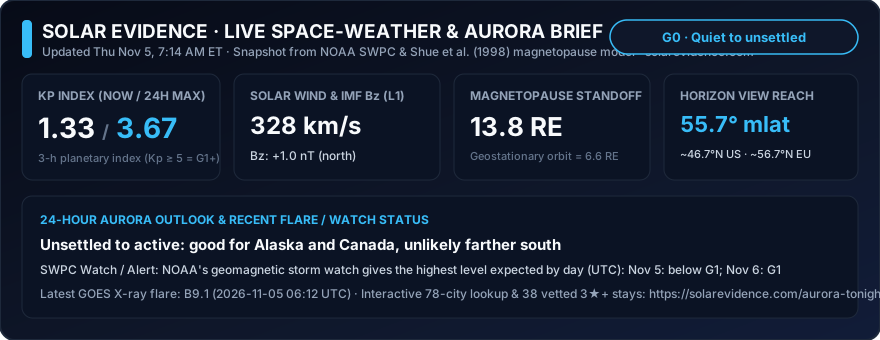
Geomagnetic field now quiet
Field quiet; magnetosphere somewhat expanded under low-pressure solar wind.
| Kp (latest 3 h) | 1.33: below storm level interval from Thu Nov 5, 09:00 UTC · 4:00 AM ET · 2:00 AM MT · 1:00 AM PT |
|---|---|
| Dst | -6 nT: quiet (above -30 nT) Thu Nov 5, 11:00 UTC · 6:00 AM ET · 4:00 AM MT · 3:00 AM PT |
| Solar wind | 328 km/s, 1.54 p/cm³ Thu Nov 5, 12:09 UTC · 7:09 AM ET · 5:09 AM MT · 4:09 AM PT |
| IMF Bz / Bt | +0.3 nT (northward) / 5.1 nT Thu Nov 5, 12:10 UTC · 7:10 AM ET · 5:10 AM MT · 4:10 AM PT |
| Magnetopause | 13.8 Earth radii (dynamic pressure 0.28 nPa) |
| GOES-19 Hp | 97.4 nT (6-h low 73.8 nT) No sign of a magnetopause crossing in the last 6 h Thu Nov 5, 12:11 UTC · 7:11 AM ET · 5:11 AM MT · 4:11 AM PT |
Full geomagnetic dashboard: how each number is measured, the model and the sources →
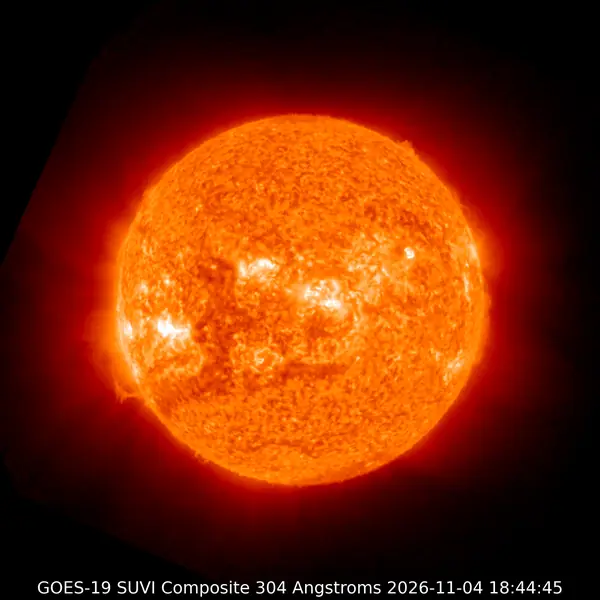
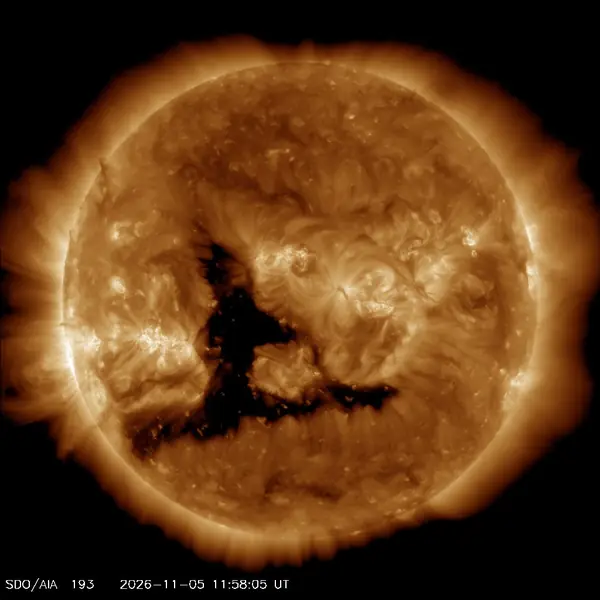
Live Spacecraft Views of the Sun: Left shows the cooler lower atmosphere and erupting filaments (GOES-19 SUVI). Right shows the million-degree outer corona and dark coronal holes that send fast solar wind toward Earth (NASA SDO).
The Sun right now

Next up in the sky
- Planets Mars–Jupiter close pairing
Nov 16, 02:04 UTC · 9:04 PM ET, Nov 15 · 7:04 PM MT, Nov 15 · 6:04 PM PT, Nov 15
72′ apart, 88° from the Sun. - Meteors Leonids meteor shower peak
Nov 17, 23:45 UTC · 6:45 PM ET · 4:45 PM MT · 3:45 PM PT
ZHR about 15; Moon 55% lit · 2026 viewing guide → - Meteors Geminids meteor shower peak
Dec 14, 14:00 UTC · 9:00 AM ET · 7:00 AM MT · 6:00 AM PT
ZHR 150; Moon 25% lit · 2026 viewing guide → - Season December solstice
Dec 21, 20:50 UTC · 3:50 PM ET · 1:50 PM MT · 12:50 PM PT - Moon Supermoon (full Moon near perigee)
Dec 24, 01:28 UTC · 8:28 PM ET, Dec 23 · 6:28 PM MT, Dec 23 · 5:28 PM PT, Dec 23
356,738 km (221,667 mi) from Earth
All eclipses, meteor showers and sky events for the next two years →
Claims Directory: Both Sides of the Argument see all 15 claims →
Featured section: Geomagnetic Field & Pole Shift (field decline, magnetic north drift, the South Atlantic Anomaly, and physical pole-shift proposals) · Featured review: Solar Micronova Evidence Review.
The Electric Sun hypothesis
The Sun is powered mainly by external electric currents flowing through space, not by nuclear fusion in its core.
ContestedHow strong would Solar Cycle 25 be? The prediction debate
Solar Cycle 25 would be a weak cycle similar to Cycle 24 (the 2019 NOAA/NASA/ISES panel consensus). A competing 'terminator' method argued it could be one of the strongest on record.
Leading Edge / ContestedWill a grand solar minimum cause a 'mini ice age'?
A grand solar minimum like the Maunder Minimum is coming in the next decades and will cause a 'mini ice age' that cancels out global warming.
Leading Edge / ContestedElectric comets (Electric Universe / Thunderblog claims)
Comets are dry, electrically charged rocks. Their jets and glowing tails come from electric sparks in the solar wind, not from ice melting in sunlight.
Leading Edge / ContestedSolar activity triggers earthquakes
Solar activity, such as solar-wind surges, flares or geomagnetic storms, triggers large earthquakes, so space weather can be used to forecast them.
Leading Edge / ContestedThe 'solar micronova' / solar flash
The Sun undergoes a recurring 'micronova' outburst, roughly every 12,000 years, that will soon strike Earth and cause a global catastrophe alongside a geomagnetic pole shift.
MainstreamEarth's magnetic field is weakening
The overall strength of Earth's magnetic field has been falling since direct measurements began in the 1800s.
ContestedA geomagnetic reversal is overdue or imminent
Earth's magnetic field is overdue for a polarity reversal, and the current weakening shows that one is about to happen.
MainstreamThe magnetic north pole is racing toward Siberia
The north magnetic pole is moving quickly from the Canadian Arctic toward Siberia.
MainstreamThe South Atlantic Anomaly is growing and splitting
The weak spot in Earth's magnetic field over the South Atlantic is expanding, deepening and dividing into two lobes.
Leading Edge / ContestedA magnetic pole reversal would cause mass extinction or catastrophe
Geomagnetic reversals or excursions trigger global environmental crises, including extinctions.
Leading Edge / ContestedA reversal would leave Earth unprotected and strip the atmosphere
During a magnetic reversal Earth would lose its magnetic protection, and the solar wind would strip away the atmosphere.
Leading Edge / ContestedSolar activity causes pole shifts
Activity on the Sun (flares, CMEs, a 'micronova' or similar outbursts) triggers geomagnetic reversals or physical pole shifts.
Leading Edge / ContestedRapid crustal displacement (Hapgood, Chan Thomas)
Earth's outer crust can slide rapidly over the interior. This would move the geographic poles to new locations in days and cause a global catastrophe.
Leading Edge / ContestedECDO: Exothermic Core-Mantle Decoupling - Dzhanibekov Oscillation
Periodically, Earth's core and mantle unhook, and the outer crust flips 104° to a new spin position before flipping back. The author argues this causes global floods recorded in ancient monuments.
Plain-English Guides see all 17 guides →
What the Kp index means for seeing the aurora
AuroraHow to see the northern lights in the US
AuroraBest US places and times to see the aurora
Space weather historyThe Carrington Event of 1859
Space weather impactsSolar storms and the power grid
Solar physics basicsThe solar cycle, explained
Solar physics basicsCoronal mass ejections (CMEs), explained
AuroraHow to photograph the northern lights with a phone or camera
AuroraHow to read an aurora forecast: the best free tools and apps
AuroraBest time of year to see the northern lights (and best time of night)
AuroraCan you see the northern lights in Virginia, the Mid-Atlantic or the Midwest?
GearGear for watching the aurora and observing the Sun
AuroraNorthern lights by US state and Canadian province: geomagnetic latitudes & Kp thresholds
AuroraBest month to see the northern lights: Iceland vs. Tromsø vs. Lapland vs. Alaska & Canada
Eclipses & sky eventsAugust 2, 2027 Total Solar Eclipse: 6m 22s totality over Luxor, Spain, Gibraltar & North Africa
Eclipses & sky eventsPerseids, Geminids & major meteor showers: radiant physics, peak dates and dark-sky guide
Eclipses & sky events13 April 2029: A 41-Million-Ton City-Killer Threading the Needle at 19,656 Miles (31,634 km)
Eclipses & sky eventsLeonids Meteor Shower 2026 Viewing Guide: Nov 17–18 Peak, Moonless Pre-Dawn Window & 71 km/s Physics
Eclipses & sky eventsGeminids Meteor Shower 2026 Viewing Guide: Dec 13–14 Peak and an Early-Setting Crescent Moon
Space weather impactsSpace weather and airplane electronics: a known risk that is not well understood
Data: NOAA SWPC solar-cycle indices, based on WDC-SILSO sunspot numbers. Solar Cycle 25 smoothed sunspot peak so far: 160.9 (2024-10). Latest monthly sunspot number: 45.7 (2026-10, preliminary).